
Push your data. We do the rest.
Autonomous Security Operations
Push
Send us everything. Raw.
- Any source, any volume
- No schemas, no pipelines
- Nothing trimmed, nothing dropped
Detect
We handle the rest.
- Caught the moment it happens
- Every detection that fits your data
- All running at once
Act
Results, not alerts.
- A finished investigation, in seconds
- Containment on your terms
- Nothing reaches you unqualified
Detection speed isn’t a feature. It’s an architecture.
Batch systems can’t get here, whatever they charge you.
With spotr.io
Mean Time to
Detect
Detect on the stream
<1.8 Sec
Mean Time to
Contain
Auto-remediate on verdict
<2.7 Sec
Mean Time to
Investigate
Autonomous investigation
<63 Sec
Traditional Solutions(store and query)
Mean Time to
Detect
Batch rules & scheduled searches
>60 Min
Mean Time to
Contain
Playbooks & change control
~3 Hrs
Mean Time to
Investigate
Manual analyst triage
~24 Hrs
Augmented*(bolted on AI SOC)
Mean Time to
Detect
Batch rules & scheduled searches
>60 Min
Mean Time to
Contain
Playbooks & change control
~3 Hrs
Mean Time to
Investigate
Some automation
>3.5 Hrs
*Ask it: if this is AI, why is investigation still 30+ minutes? That’s a human loop—on detections the AI doesn’t control.

Just send us all
your raw data.
We will do
the rest.
Send us everything. Raw.
Every new source is a project today: a parser to write, fields to map, decisions about what to keep. Then again for the next one.
Point one at us and it’s live. Send it straight from the source, or use whatever you already have — a collector, a cloud export, the feed already going to your SIEM. No schema. No parser. No migration.
And nothing needs trimming. You sample and drop fields because every byte costs you whether or not anything ever looks at it. On the stream, everything gets looked at. Send all of it.
Any volume
Terabytes/day
Learned, not configured.
Every platform starts by asking what you have. You describe your estate, or hand over an inventory that was accurate the day someone wrote it — and coverage gets built on that description.
Here it comes from the data instead. As records arrive we work out what each field actually is — an address, an identity, a resource — without a parser written for that source. That’s what turns the right detections on, and what tells enrichment which context belongs where.
And it never stops. A new source, a new field, a system nobody mentioned — it shows up in the data, and it’s covered.
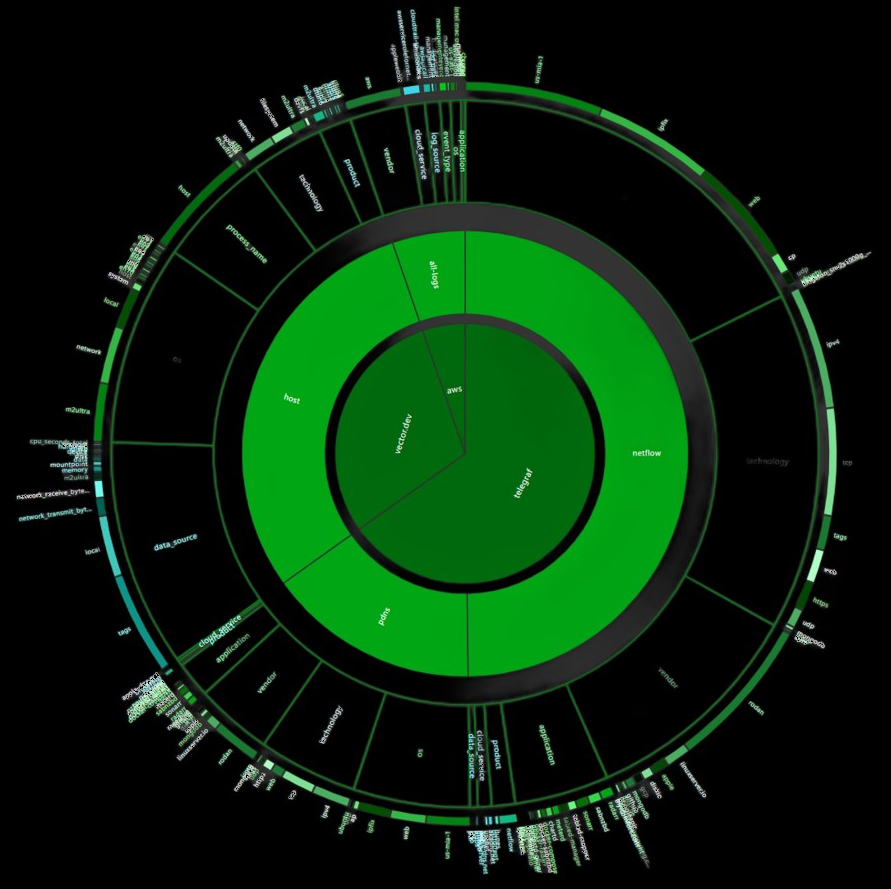
Context arrives with the data.
Threat intelligence is usually something you buy, maintain, and remember to apply — a feed subscription, a lookup table someone keeps current, a join written during an investigation. By then the detection has already run without it.
We curate and maintain all of it for you. Because discovery already established what each field holds, it lands on the right fields as records arrive — intelligence on the address, ownership on the asset, history on the identity. Nothing to subscribe to, nothing to map, nothing to keep current — and your own feeds drop in alongside ours.
That’s why detections act on all of it rather than raw fields, and why an investigation opens with the evidence already attached. The enriched records are yours as well — sink them wherever you keep data for retention and compliance.
Maintained for you. Applied on arrival. Yours to keep.
Detection on the stream, not on a schedule.
Today you choose which detections to run, and how often — not because you want to, but because every one you turn on takes budget from the rest.
Here everything runs at once. Records are evaluated as they land: no parse-and-index step in front, no schedule, no window where you’re blind between runs. A detection fires the moment the event that completes it arrives.
Thousands run concurrently and scale out past anything you’ll need, so capacity never decides your coverage. What runs is what matches your data, reassessed continuously as your environment changes. Depth costs no more than breadth. The detections that need it are the ones that catch a real attack — and the first you cut when something has to give.
- Bring the detections you already have — your Sigma and Elastic rules come with you
- Ours are curated and kept current, so new coverage arrives without a project
- Need something specific? Describe it and our detection engineering agent builds it
Nothing reaches you unqualified.
Today every alert is yours. Something fires, a person opens it, gathers the context, decides whether it matters — then does it again, a few hundred times a week.
Here it’s settled before you see it. Most signals stop at the learning engine in milliseconds — known-benign, already seen. Most of the rest stop at the decision engine, weighed against evidence and history, recorded either way. Only what survives both reaches the AI analyst. What reaches you is a finished investigation: what happened, what it means, what to do.
Which is why a full investigation adds nothing to your bill, and why one starting at 3am on a Sunday gets the same treatment as one on a Tuesday morning.
Then it’s your call.
Containment today means a playbook, an approval, and somebody free to run it. The decision is usually right. It’s just hours late, and hours is the whole game.
Here the actions are already wired — isolate a host, disable an account, revoke a session — whether or not you ever fire them. Every one is reversible, and every one is yours to switch on when you trust it. Until then results land where your team already works: Slack, Teams, ServiceNow.
Investigation fails open. Containment fails to a human.
As autonomous as you want it to be.
Detect and contain threats in seconds, not hours not hours - at 90% lower cost.
Keep your SIEM. Replace it. Or skip it entirely.
We take it from here
- Discover
- Enrich
- Detect
- Contain